
An Organization is the top-level management unit in AirCloud. Members, Projects, usage, and billing are all managed at the Organization level.

Best Practices for Managing Your Organization

  • Create separate Projects for API testing and production workloads.
  • Define member roles and project access permissions to keep your organization secure.
  • Regularly review usage and billing to avoid unexpected costs.
  • Verify your available credits and billing status before deploying workloads.

Invite Members

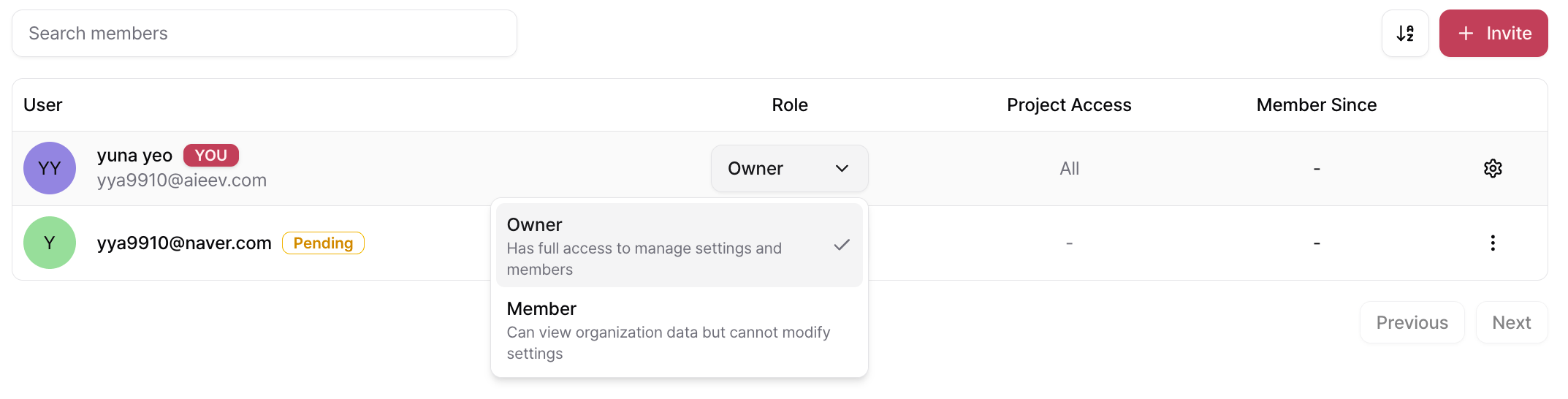
You can invite members to your Organization and assign roles. Permissions are determined by each member’s assigned role. Member Eng
RoleDescription
OwnerFull administrative access to the Organization, including member management, billing, credits, and creating or deleting Projects.
MemberCan access assigned Projects and use AirCloud services, but cannot modify Organization settings or access billing features.
To invite a member:
  1. Open the Members tab in the Organization page.
  2. Click + Invite in the upper-right corner.
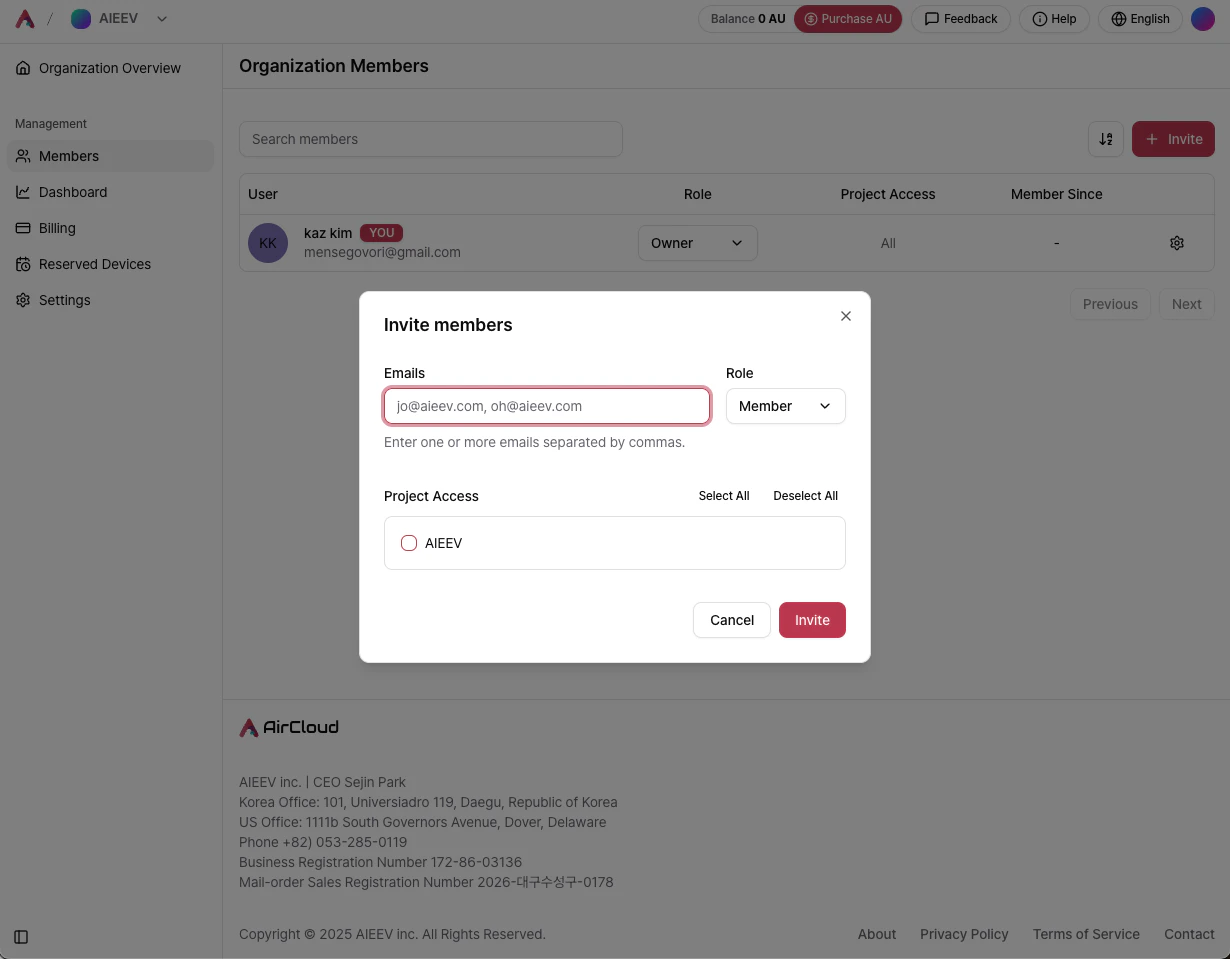
Invite Members Then complete the following steps:
  1. Email Address — Enter the email address of the member to invite. Multiple email addresses can be entered, separated by commas.
  2. Role — Select either Owner or Member.
  3. Project Access — Choose which Projects the member can access. You can grant access to all Projects or select individual Projects.
  4. Send Invitation — Click Invite to send an invitation email.

Before Inviting Members

  • Each AirCloud account can belong to only one Organization. Members who already belong to another Organization cannot be invited.
  • The invited user must register using the same email address that received the invitation.
  • If the invited user is already signed in to another account, they should sign out before accepting the invitation to avoid authentication issues.

Usage Management

Usage

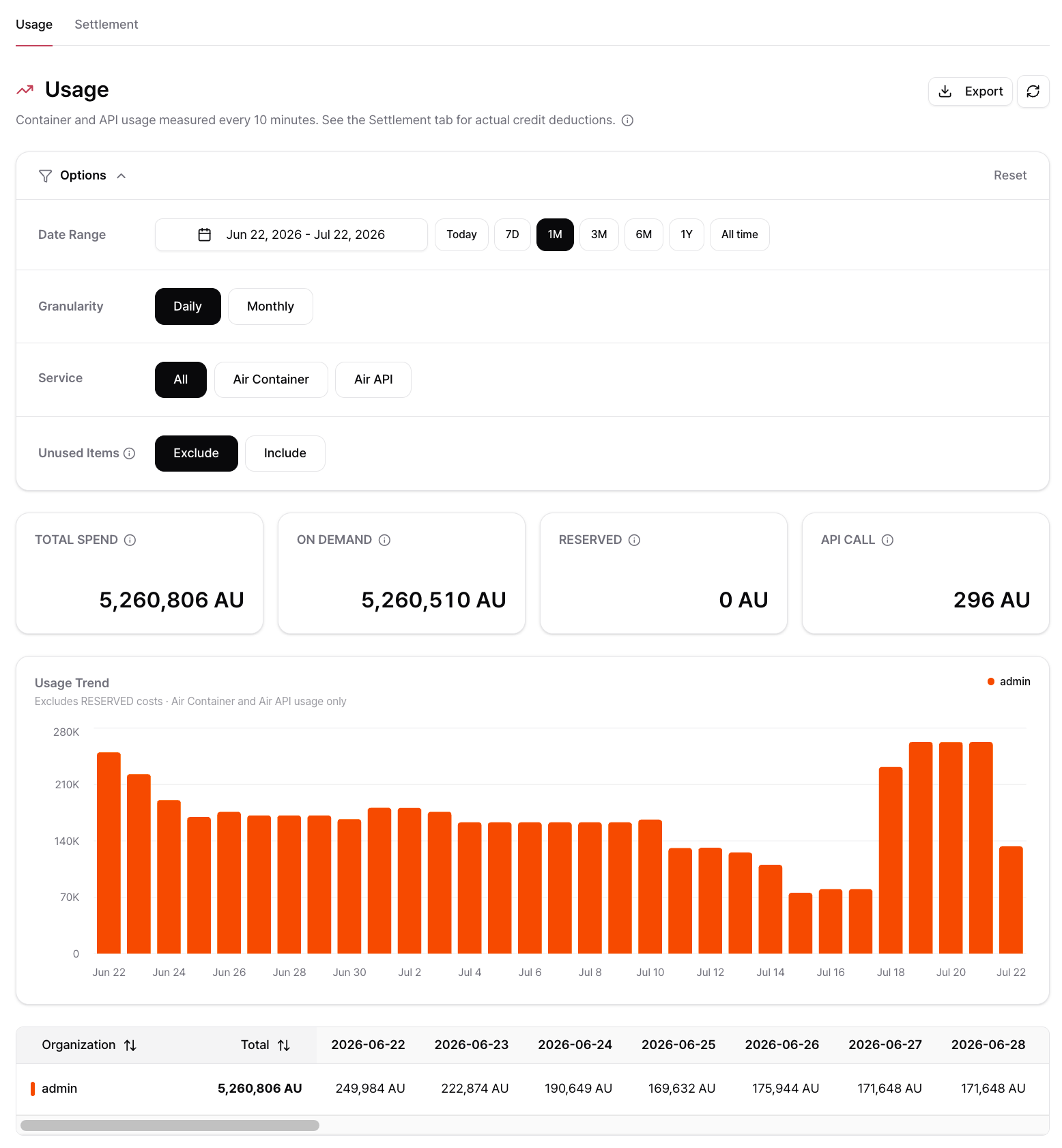
The Usage page provides an overview of your Organization’s spending over time. Summary cards display total spending, highest daily spending, service costs, and the number of active Projects. Spending trends are also visualized using charts and tables.
Usage Management Eng482

Service Filters

ServiceDescription
AllCombined usage for Air Container and Air API.
Air ContainerUsage for Air Container only.
Air APIUsage for Air API only.

Group By

ServiceAvailable Grouping Options
Air ContainerProject / Container / Instance Type
Air APIProject / Model / Model Type

Time Filters

  • Date Range — Select a custom start and end date.
  • Preset Range — Quickly select common ranges such as 1 Month or 3 Months.
  • Aggregation — View usage aggregated by Day or Month.

Transaction History

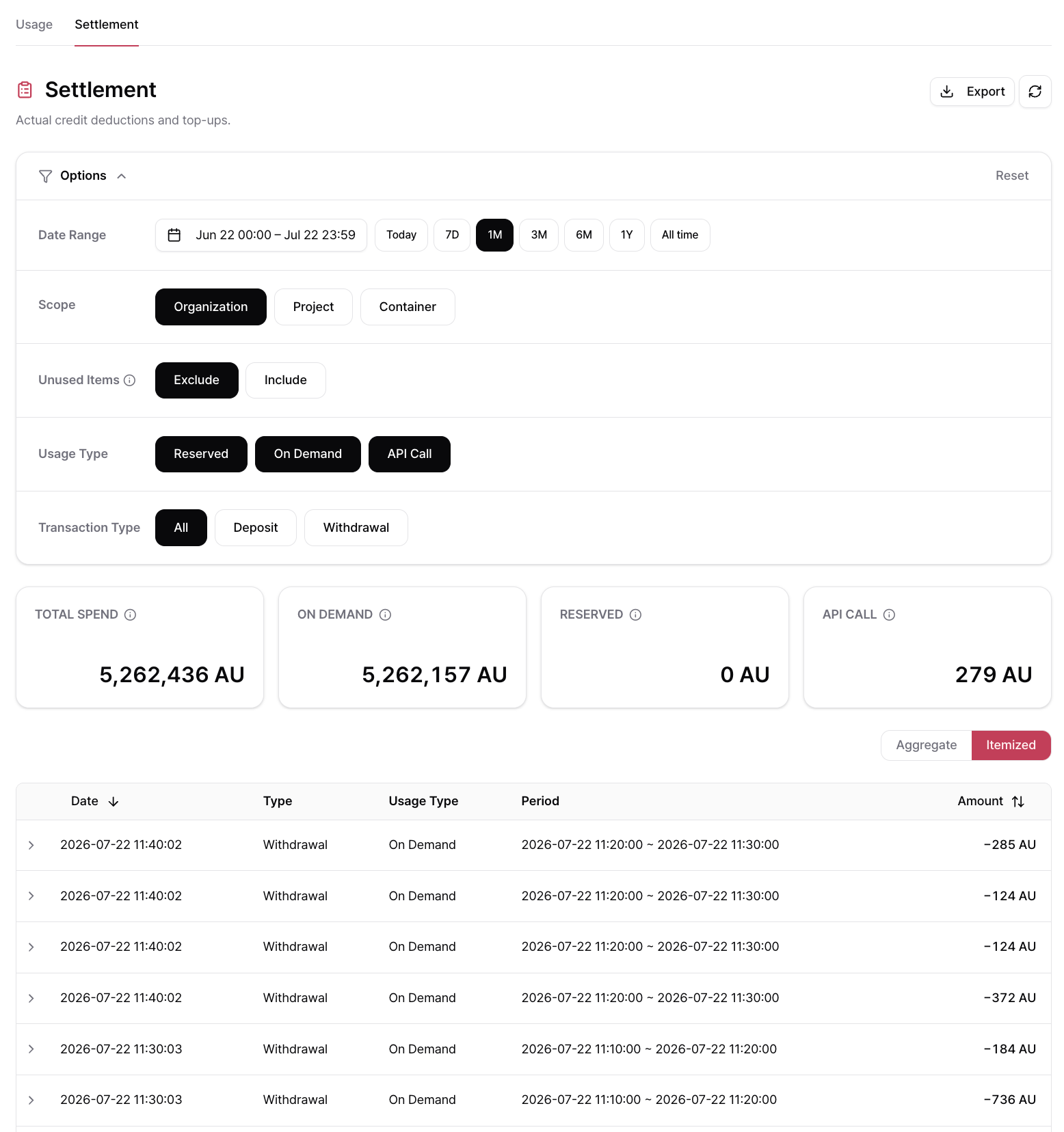
The Transactions page records all AU deductions in 10-minute intervals. Rather than simply showing billing history, it provides a detailed operational view of workload spending over time. Transaction History Eng Transaction history can help you:
  • Identify Autoscaling events by correlating increases in AU consumption with Replica scaling.
  • Verify actual costs by reviewing spending at 10-minute intervals.
  • Analyze resource efficiency, such as identifying workloads that continue to incur costs during periods of low traffic.

Transaction Table

ColumnDescription
Transaction DateTime when AU was deducted.
TypeTransaction type (for example, Debit).
Usage TypeBilling type, such as ON_DEMAND, RESERVED, or API_CALL.
DescriptionBilling period associated with the transaction.
Amount (AU)AU deducted during the billing interval.

Filters

The Transactions page provides several filters to help you analyze billing data more effectively.

Group By

To identify which container generated a particular cost, change Group By to Container. Deleted containers are also included, making it useful for historical cost analysis.
OptionDescription
OrganizationDisplays all transactions across the Organization.
ProjectFilters transactions by selected Projects.
ContainerDisplays transactions by container, including deleted containers.

Usage Type

OptionDescription
AllDisplay all usage types.
ON_DEMANDOn-demand GPU usage.
RESERVEDReserved Instance usage.
API_CALLAir API usage.

Transaction Type

OptionDescription
AllDisplay both credits and debits.
DebitAU deducted for service usage.
CreditAU added through credit purchases or promotional codes.

Date Range

Select a start and end date to display transactions within the specified period.
If spending is unexpectedly high during a particular period, narrow the date range and group transactions by Container to identify the responsible workload.

Export Transactions

Click Export in the upper-right corner to download the filtered transaction history. You can configure:
  • Date Range
  • Columns (including custom column order)
  • File Format (CSV, JSON, or TXT)
Exporting a large number of transactions may take several minutes.

Reserved Instances

Reserved Instances allow you to reserve GPU resources for three months or longer. Reservations are arranged through the AirCloud team rather than directly through the Console. To request a reservation, contact us with your preferred GPU type and reservation period. Compared to On-demand instances, Reserved Instances provide lower hourly pricing and guaranteed capacity.
Reserved GPU resources are shared across all Projects within the Organization rather than being dedicated to a single deployment.

Reservation Details

  • Reservation Term — Minimum reservation period is 3 months. Longer terms receive larger discounts.
  • Billing — Reservations are prepaid by default. Enterprise customers may also be billed by invoice.
Reserved Instances are managed from Organization → Reserved Instances.
StatusDescription
ActiveReservation is active and available for use.
ScheduledReservation has been confirmed but has not yet started.
CompletedReservation period has ended.
CanceledReservation has been canceled.

Organization Settings

The Organization Settings page allows Organization Owners to manage basic organization information, billing methods, and payment methods. Changes take effect only after clicking Save.
FieldDescription
Organization NameName used to identify the Organization.
DescriptionBrief description of the Organization.
Billing MethodPrepaid or Postpaid.
Payment MethodRegistered payment method used for credits or invoices.
Organization IDUnique identifier assigned when the Organization is created. This value cannot be changed.
AirCloud uses a prepaid billing model by default. Postpaid billing is available for selected enterprise customers.
Billing MethodDescription
PrepaidPurchase AU credits in advance and consume them based on usage.
PostpaidUse the service first and receive an invoice according to the billing cycle.
For Postpaid billing, available AU credits are consumed first. Once the balance becomes negative, usage continues to accumulate as a negative balance. At the end of each month, an invoice is automatically generated for the outstanding amount. After payment is completed, the balance is reset to zero. Enabling Automatic Payment allows invoices to be paid automatically using the registered payment method.

Billing

Learn how to purchase credits, configure Auto Top-up, and manage invoices.

Contact and Feedback

Contact the AirCloud team or submit product feedback.