> ## Documentation Index
> Fetch the complete documentation index at: https://docs.aieev.com/llms.txt
> Use this file to discover all available pages before exploring further.
# Container Management
> Manage the container lifecycle, data persistence, and tags
## Start, Stop, and Restart
A deployed container can be in one of five states. Billing and data persistence depend on the current container state.
### Container States
| State | Description | Billing |
| ------------------------ | ------------------------------------------------------------------------------------ | -------------- |
| 🟢 **Running** | The container is running normally. | Charged hourly |
| 🟡 **Updating** | The container is restarting to apply configuration changes. | Charged hourly |
| ⚫ **Pending** | The container is not running and no compute resources are allocated. | Not charged |
| 🔴 **Deployment Failed** | An error occurred during deployment, such as a failed image pull. | Not charged |
| 🔴 **Unhealthy** | The container is running but has failed health checks or is not operating correctly. | Not charged |
If you do not use **Persistent Storage**, all data stored inside the container will be lost when the container is stopped or restarted. To preserve your data, make sure Persistent Storage is enabled.
Hourly charges apply only while the container is in the **Running** or **Updating** state. Containers in the **Pending**, **Deployment Failed**, or **Unhealthy** state are not billed.
### Stop a Container
Stopping a container changes its state to **Pending**.
* Compute resources are released and billing stops.
* Starting the container again launches a new container instance.
### Data Persistence
Whether your data is preserved depends on whether **Persistent Storage** is enabled.
For setup instructions, see [Persistent Storage](/docs/air-container/shared-storage).
| Scenario | Without Persistent Storage | With Persistent Storage |
| -------------------------- | -------------------------- | ----------------------- |
| Stop and start a container | Data is lost | Data is preserved |
| Restart a container | Data is lost | Data is preserved |
## Container Tags
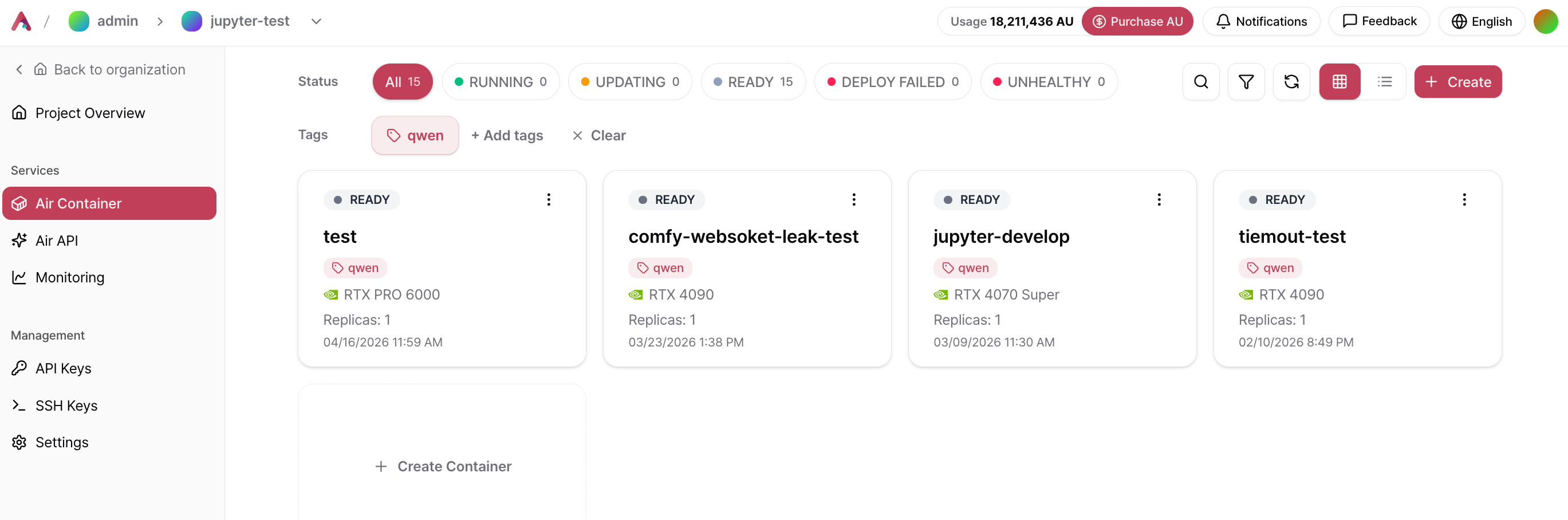
Tags allow you to organize containers into custom groups. As the number of containers grows, tags make it easier to group and filter containers by purpose, project, or model family.
 ### Create and Assign Tags
Click **+ Add Tag** at the top of the container list, create a tag, and select the containers you want to assign it to.
A single tag can be assigned to multiple containers.
### Filter by Tag
Click a tag in the tag list to display only the containers associated with that tag.
Click **Clear Selection** to return to the full container list.
## Related Documentation
Learn how to persist data across container restarts.
Learn how to configure Autoscaling and Scheduled Scaling.
### Create and Assign Tags
Click **+ Add Tag** at the top of the container list, create a tag, and select the containers you want to assign it to.
A single tag can be assigned to multiple containers.
### Filter by Tag
Click a tag in the tag list to display only the containers associated with that tag.
Click **Clear Selection** to return to the full container list.
## Related Documentation
Learn how to persist data across container restarts.
Learn how to configure Autoscaling and Scheduled Scaling.